
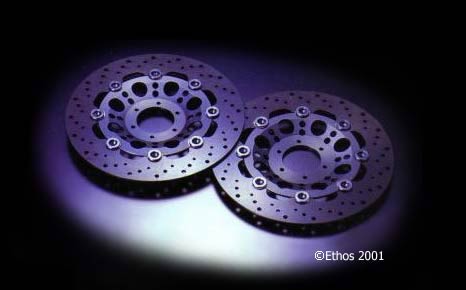
Although extremely competent for a road bike, the NSR250's brakes are virtually always overlooked!
During model evolution, apart from the increased front rotor diameter in 1988 for the MC18 R2/4J, the braking system was the only area Honda never deemed it necessary to significantly update. MC16's were equipped with twin piston sliding callipers and semi-floating 156mm discs, but after the change to 4 piston callipers and 276mm discs on in 1988, the brakes have remained largely unchanged. The 88-93 calipers are are based on the NF5/RC30 castings, and the "updated" MC28 callipers are found across a wide range of late '90s and early 2000s model Hondas.
MC18 and MC21 calipers share pads with the original (round headlight) CBR900RR Fireblade, and for the MC28, simply use "late model" Fireblade pads from the equivalent year!
BRAKE FLUID.
Brake fluid is hydroscopic, meaning over time it absorbs moisture. As the brakes are applied, the moisture boils and tiny air bubbles form, the result is a lever that feels 'spongy', or in extreme cases, will just squeeze back to the clip-on! Not a nice sensation! The fluid should be changed every season, or even more often if you race or regularly attack track days. Generally, the darker the brake fluid, the sooner it needs replacing. Just open a new bottle and you will see that new brake fluid is almost clear.
There are 3 common types of brake fluid:
- DOT-3: This is an older fluid used in the earlier days of automotive hydraulic braking systems. It is very hydroscopic and is the reason for the frighteningly bad brakes on your aunties Mini! This grade of fluid should be avoided.
- DOT-4: This is the most common fluid, and is now used by the majority of manufacturers. It has a high boiling point, around 260ºC, dropping to 165º when contaminated by water (known as the 'wet' boiling point), and is fairly resistant to moisture.
- DOT-5: This is a more recent addition to the market. It is a silicone based fluid, even more resistant to moisture, but prone to retaining air. (I know, I had a nightmare trying to bleed my system the first time I used it!) It has an even higher boiling point than DOT-4, 270ºC (186C wet), but compresses more readily giving a spongier feel under heavy braking. It is an acquired feel. DOT-5 fluid is also known to effect some types of rubber seal, causing them to swell and produce a 'sticky' action.
| Do not mix DOT-3/DOT-4 (Glycol based) fluid with DOT-5 (Silicone based) fluid. |
| Note: | In the interests of safety, if changing from DOT-3/DOT-4 to DOT-5 or vise-versa, make sure that the system is thoroughly flushed, and when changing or topping up your system, only ever use fluid from a new, sealed container. |
BRAKE PADS.
It's a popular misconception that the stock OE (original equipment) pads need "binning"! For the majority of riders the standard pads are superb. Remember, they are specifically designed to work with the disc material, the bike, and its intended riding style. If however, you and your bike habitually see the aforementioned track days, or are "the last of the late brakers", you may want to consider an upgrade.
Another reason for switching pads is the cost of the genuine replacement, Honda pads can be up to 50% more expensive than aftermarket options.
HRC replacement pads are available in racing compound (part# 45105-NKD-970) and endurance compound (part# 45105-MN8-006). These pads will suit MC18 R5K through MC28. As you would imagine, the racing pads wear considerably faster than the endurance pads but do warm up to optimum temperature much quicker.
Various manufacturers market aftermarket pads, Brembo, EBC, and Ferrodo, to name a few, and each often come in different grades allowing you to choose a characteristic to suit your own particular application.
A sports compound such as Brembo's Green Pad is recommended for fast road use over a racing compound. The racing compounds are designed to work more efficiently at higher temperatures, thus reducing fade, so are not as effective at normal lower speeds where they can't reach their optimum operating temperature.
Brembo Green pads are available in the UK from M&P Accessories part# BB-HO28 for the front, again suitable for MC18 R5K through MC28.
When replacing pads apply a little anti-seize compound such as "Coppa-slip" to the backplate and also to the pad retaining pins. The pad retaining pins should be regularly removed and cleaned to allow a smooth action, and also replaced every couple of seasons.
If used under extreme conditions the caliper dust covers can be left off to aid cooling.
BRAKE LINES.
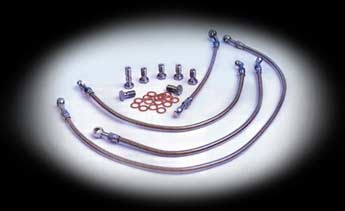
High on anyone's shopping list has to be braided lines, more often for looks, than functionality! Modern stock lines are more than adequate for the majority of riders, but aero-quip hoses DO look the business! The only serious problem with stock lines is the fact that they can perish over extended periods of time and the fittings become corroded. On average, 80% of the lines taken off road bikes are usually fine! This isn't to say that under the right conditions, a braided set-up isn't a superb upgrade though, and great attention must be paid to the braking system at all times. If replacing lines, braided steel is the logical replacement!
| HEL Performance are our preferred supplier of brake line kits and associated braking products, and can now be purchased at a special discounted rate for NSR-WORLD.COM Supporting Members. |
Finding brake lines custom made for the NSR range can be difficult, so persevere, and if you do have to have them made to order make sure you allow for enough free length for when the suspension is fully extended, the last thing you want is to have the front wheel in the air and the lines ripping themselves out of their sockets... it does happen, often!
Most companies will supply a clear 'heat-shrink' PVC coating now, and it is highly recommended for keeping the braiding clean from brake dust.
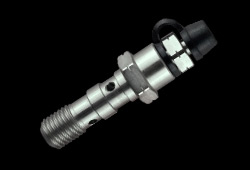
Another highly recommended addition is a bleed nipple on the master cylinder, and an item included in the MC28's HRC kit. (HRC part# 45530-NX5-000) This makes bleeding the system much easier when replacing the fluid. As this is an RS125 part, it may need to be ordered through an HRC dealer.
The RS125 bleed bolt is longer than the NSR's so use 2 copper washers for each join instead of 1, as spacers.
MASTER CYLINDER
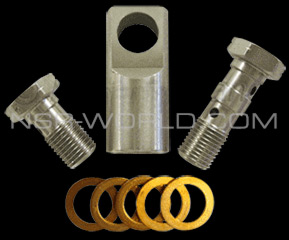
A highly recommended upgrade for all NSR's is a radial master cylinder. With the huge market in replacement master cylinders these days, it is extremely easy to pick up excellent used CBR1000RR master cylinders for around £40 (US$60), and it's a fantastic upgrade in terms of both performance and feel. An adaptor can be used to fit your conventional brake lines to the radial master cylinder output in our marketplace.
CALIPERS.
The calipers are one item on the NSR that really don't need changing. As mentioned earlier, they were originally designed to haul up a lot more weight than your average 2 stroke race rep! The best thing to do to them is to thoroughly clean them, inspect the dust seals for perishing, the pistons for any signs of wear, and the piston o-rings for fluid leaks.
When inspecting the calipers remove the brake pads and carefully apply a little pressure to the brake lever. Watch for the pistons moving. Don't squeeze the lever too hard or the pistons will pop out of their housing. The pistons should retract very slightly as you release the lever pressure.
If you are looking here for a "how to" on servicing your calipers, take your bike to a qualified motorcycle mechanic!
| Note: | The brakes are the single most important system on the bike and any work undertaken to them MUST be done by a fully competent mechanic! |
DISCS.
The stock discs are again, very good, and most riders should never feel the need to replace them until they wear to their service limit. As long as the pads are replaced regularly, i.e. not left to wear right down to the 1mm service limit each time, and the calipers kept clean so as their action never becomes sticky (and hence allowing the brakes to "bind"), the discs should easily last 60000kms, even if the bike is aggressively ridden!
VFR400 NC30 disks can be used on the NSR, but this necessitates the use of the NC30's forks due to the larger disk diameter. The conversion works extremely well though!
Another option is to use VTR1000 disks. These bolt straight to the NSR's rims but require an adaptor plate to space the callipers correctly.
"BIG DISC" CONVERSION
Each NSR can be converted to a more substantial setup.
MC16
The simplest route to take is to fit the MC18 or MC21 front-end, complete with yokes (triple-clamps). This will of course mean that the wheel will also be changed from the MC16 3-spoke item to the later 6-spoke Enkie, but you will benefit from the wider 3" rim and 276mm discs.* These parts are a direct replacement, although you will need to dress back the steering lock stops on the frame at the headstock.
The drawback of this setup on the MC16 is the decreased steering lock... and it's quite easy to trap your thumb between the 2T oil remote filler and the right clipon!
*An 18" MC18 or 17" MC21 rear rim can also be fitted relatively easily to maintain a factory style appearance. The choice of rim will largely depend on how similar you wish to keep the suspension geometry to standard. A 1988 R2J wheel is 4x18" and most similar in size to the MC16 wheel, a 1989 R5K wheel is 4.5x18", and the MC21 wheel of course 4.5x17", offering a much wider choice of tyres.
MC18 and MC21
The VFR400R NC30 setup is a very good upgrade for the MC18 and MC21. The NC30 uses 296mm discs and similar calipers to the NSR, although they do differ slightly so must be used with the conversion.* The NC30's forks are the same 41mm diameter as the NSR, so slot right into the NSR triple clamps, although the NC30 stanchions are shorter than the NSR's. Ideally an HRC RS250 NF5 top triple clamp with a modified stem to suit the NSR should be used to offset the shorter forks.
*NC calipers clear the 276mm NSR discs, but the NSR calipers will not clear the 296mm NC discs without modification!
An interesting note, if you fit the VFR forks this will also give you the opportunity to fit a 3.5" front rim too, if you are so inclined. You can then make better use of a wider 120/60x17 tyre if you wish, or a suitably sized slick if racing. The 3.5" rim is not however advised for street use, as it tends to slow the NSR's steering, and make it feel heavier!
MC28
A popular conversion of late for the MC28 is to fit the latest gold SP1 or SP2 calipers. Owners report a better feel over the standard NSR items, and also like the bling! The MC28 can also benefit from the NC30 conversion, but SP owners will not like to lose the "blue-top" adjusters, so it's not a common swap.
| Note: | NSR-WORLD.COM RECOMMENDS THAT THE BRAKING SYSTEM SHOULD BE WORKED ON BY A FULLY QUALIFIED MECHANIC ONLY. |

