

Suspension tuning is very much overlooked when trying to increase the performance of any motorcycle. This section will cover the basics of setting up the NSR's suspension, and a base setting as recommended by HRC.
This set-up is based around the MC21 SE/SP, but can be applied to the MC18 SP and MC28 SE/SP too, as these 5 models are the only NSR's with fully adjustable suspension. The R models, although they only have front and rear preload adjustment, can still benefit from this setting guide though.
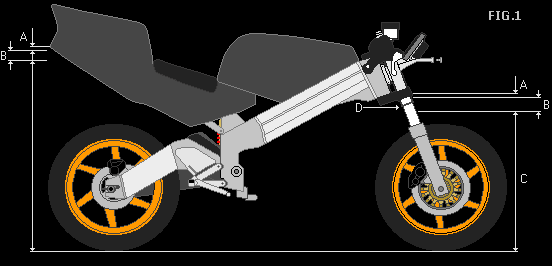
The suspension set-up comprises of three main factors, A. sag, B. spring preload, and C. ride height. Additional settings come in the form of front rebound damping, set by the 10 position "click" screws on the top of the forks, rear rebound damping, adjusted by the screw on the bottom of the shock absorber unit, and rear compression damping, set with the screw on the remote reservoir attached to the right frame spar. The NSR has no facility to externally adjust the front compression damping.
The first thing to do, as always, is to note your starting point settings. That way, if you make a complete cock-up of it all and feel the handling is worse than when you started, you can easily reset it and start again!!
Next is a visual inspection of the components. Check the fork stanchions (sliders) for rust or pitting and any traces of oil to indicate the seals reaching their "sell by date"! Check the rear shock for similar signs, and the linkage for play. Also check the swingarm pivot bearings for play, as you will never get reliable feedback unless the chassis is taught. It's pointless trying to adjust the suspension if the components are in need of servicing before you even start.
SAG.
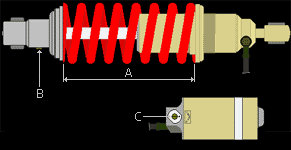
Looking at the above diagram, the starting point of any set-up is the static sag. This is best done by two people, one to manipulate the bike, one to take measurements. Supporting the bike on a paddock stand, identify a fixed point on the rear bodywork, the bottom edge of the tail unit being a good place. Lift the rear of the bike so that it's weight is just taken off the shock absorber unit and measure the height. Now lower the bike down, letting just it's own weight onto the shock. Again measure the height of the tail section to the ground. Subtract the second figure from the first, this will give the rear static sag. A measurement of around 20mm is an aiming point, and a good figure for a lightweight 250 road bike. (Race bikes will be more like 5-10mm.)
The principal is the exactly the same for the front forks. The most accurate way to measure the front sag is with a cable tie (tie wrap) wrapped around one of the stanchions (Fig.1 'D'). Lift the front end until all the weight is off the forks, and have your helper push the cable tie down until it touches the fork seal. Now let the bike settle under its own weight. Once again lift the front end and now measure how far the cable tie was pushed up the leg. Again, for road use approx. 20-25mm is good.
Sag is usually adjusted on race bikes by varying the rate (stiffness) of the springs. This isn't a practical solution for a road going NSR, so adjustments need to be made to the spring preload. "Winding up" the preload to reduce the sag has a knock on effect, as you compress the spring, you effectively raise its rate, but reduce its operational travel. The first is generally a good thing, as the majority of NSR riders will be a little heavier than their Japanese counterparts that the bike was designed for! The second effect however, is not so useful, but "one-up" riding rarely compresses the suspension enough to bottom it out!
PRELOAD.
Alter the spring preload by adjusting the spring collar on the rear shock up and down, and by screwing the 14mm adjuster nuts on the top of the forks in and out. Screw the collar or adjusters down (clockwise) to increase the preload, up (anti-clockwise) to back it off. Again, take the measurement from your fixed point at the rear to the ground, and note it down, and push the cable tie down against the dust seal on the front fork leg. Now sit on the bike and have someone take the new measurement. Subtract the second measurement from the first to get you rear preload and then get off the bike. Measure how far up the fork leg the cable tie has been pushed, this will give you your front measurement. Increase the preload on the front and rear until the travel on the forks matches the travel on the rear shock. This is now the best compromise between sag and preload.
As you wind the preload up to equalise the travel it will reduce the sag, this will stiffen the suspension slightly and give a nice balanced feel to the suspension's movement. Once again, try to keep the travel below 30mm. (Grey imports are traditionally undersprung, due to the lighter weight of the average Japanese rider, so this may not be as easy as it sounds!) Winding the preload up front and rear will also increase the ride height.
|
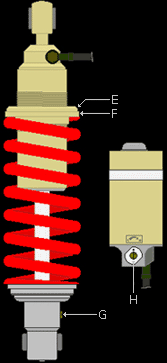
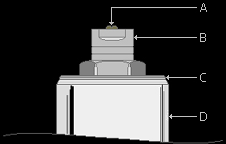
Figs.2
and 3 show the various locations of the
adjusters on the NSR suspension. They
all adjust in the same direction, Clockwise
to increase, anticlockwise to decrease. |
|
| A: | Front rebound adjuster screw - 10 clicks | |
| B: | Front Spring preload adjuster - 10 rings | |
| C: | Fork cap | |
| D: | Stanchion (fork leg) | |
| E: | Spring locking collar | |
| F: | Spring collar | |
| G: | Rear rebound adjuster - 2½ turns | |
| H: | Rear compression adjuster - 2½ turns | |
Adjustment.
Now a basic sag/preload set-up has been achieved, it's time to modify the compression and rebound damping to suit your personal preferences.
Rebound.
The function of the rebound damping is to slow the return movement of the compressed spring. With no rebound damping the spring just "bounces" back to its original position, often way too quickly, inducing a "po-go" effect!
The best way to start is with the adjust set to neutral, i.e. in the middle of it's range (-5 clicks from hard on the front and -1¼ turns from hard on the rear.) With the bike on the paddock stand, push down on the seat. Visually check the return of the bike back to normal. You are looking for a nice balanced return, not too fast, and not too slow. To get an idea of the extremes, set the rebound adjusters to minimum and try the test, and then to maximum. This will indicate the range of adjustment available.
Make sure the front and rear return together, not at different rates, and make sure that the static rebound is set slightly softer than you'd imagine as it is easier to adjust out when riding the bike.
Compression.
The compression damping is to help assist the spring under braking or over bumps. It helps slow the travel and reduce to possibility of the suspension reaching its maximum travel too soon. (There's nothing worse than bouncing off the bump stops!)
Set the compression adjuster on the rear shock to -½ turn from hard to start. More rear compression will help prevent "squat" under acceleration or very hard cornering giving more stability.
Riding and final set-up.
You are now ready to take the bike out on the road. If you have had the bike for a while, and covered a lot of mileage on it, do not be surprised to feel dissatisfied with the new "feel" of it, this is normal!
Ride on you favourite, quiet road. This road should have a good cross section of corners, crests, and hollows, and be somewhere you can ride quickly but safely, and of course, within the speed limit!!
Make a comparison of how the bike feels now to how it did before. Do you feel the front is diving too fast under braking? Then wind the preload adjuster in a ring. Does the rear feel like it's wallowing under acceleration? Yes, then wind the rear compression up ¼ of a turn. Another common problem with the rear shock is the feeling that it is kicking you up the backside! More rebound damping will help dial this out. Riding the bike is the only way to make the final adjustments, and be prepared to spend a lot of time tweaking until you get the "feel" just right!
HRC Recommended Base Settings.
Although HRC supply uprated springs for the front forks and the rear shock with their race kit, their basic settings work well with the standard kit. The set-up may be a little harsh for normal road use, especially on bumpier UK roads, and may need to be "backed off" a little, but it is a good starting point.
A useful note here is that the coil spring on the 'R' shock is longer than the SE/SP spring. This makes a for a good cheap upgrade when the "R' spring is fitted to the SE/SP.
Again, bear in mind that HRC assumes your suspension is both kitted with uprated springs and rebuilt with fresh oil to their race specifications.
Front
|
MC21
MC28
|
Rear
|
MC21
MC28
|
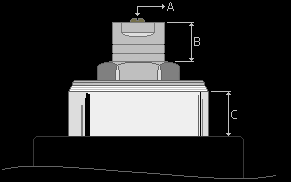
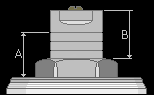
| For
the MC21, HRC measure from the top face
of the preload adjuster to the top face
of the locknut to set preload (B); but on
the MC28 measure from the top ring groove
to the bottom face of the
locknut (A), as demonstrated in the diagram
below.
They also specify the number of rings wound into the fork body on the MC28, not the number of rings left showing! |
MC21 HRC:
HRC specify 10Wt oil for all models. For the MC21R use 425cc, with a measurement of 120mm from the top of the leg to the oil level; for the MC21SE/SP use 384cc and 161mm oil level.
MC28 HRC:
HRC specify 10Wt oil for all models. For the MC28R use 425cc, with a measurement of 105mm from the top of the leg to the oil level; for the MC28SE/SP use 383cc and 145mm oil level.
This may still be too light for Western riders, and a good compromise is a 50:50 mix of 10wt and 15wt to give 12.5wt.
| Note: | Only mix 2 similar oils, i.e. 2 grades from one manufacturer, to ensure compatibility. |
The stock MC28R and SE/SP should use 450cc/105mm and 383cc/145mm respectively for the oil capacity and level measurement; no figures are currently available for the stock MC21 models.
| Note: | When measuring the oil level (not the capacity), measure it without the fork springs fitted. |
HRC fork springs for the MC21 are part# 51402-NH3-761 rated at 0.6-0.85 kgf/mm & 51403-NH3-761 rated at 0.7-0.9 kgf/mm, and for the MC28 are part# 51401-NKD-970 rated at 0.95 kgf/mm. The fork springs are NOT interchangeable between MC21 and MC28.
HRC rear springs are available for the MC21, part #'s 52401-NH3-761, 52402-NH3-761, and 52403-NH3-761 rated at 12, 13, and 14 kgf/mm respectively. MC28 rear springs are part#'s 52401-NKD-970 and 52401-NKD-980, rated at 11 and 13 kgf/mm respectively. The stock MC28 spring is rated at 12 kgf/mm.
The HRC rear shock for the MC21, should you be able to source one (and it is increasingly unlikely!), is part# 52400-NH3-761. This is the F3 shock and it has the added benefit of a ride height adjuster over the stock unit. This shock was never listed for the MC28 because by the time it was released, F3 250's were no longer raced in Japan.
Remember, all settings in this guide are base settings and will need adjusting to suit your particular weight and riding style.
| NSR-WORLD.COM ACCEPTS NO RESPONSIBILITY FOR ANY MECHANICAL OR PERSONAL CONSEQUENCE ARISING FROM THE INTERPRETATION OF THIS DOCUMENT OR THE MODIFICATION OF ANY COMPONENT REFERRED TO WITHIN IT, AND RECOMMENDS THAT ANY MODIFICATION ONLY BE CARRIED OUT BY A SUITABLY QUALIFIED MOTORCYCLE MECHANIC. |


